
The checking routine
Six signals that show whether an agent still has its lights on
Domain, pages, payment, support, social accounts and the app listing. Each check takes a few minutes, needs no account with the agent, and leaves you with a dated note you can compare against next week.
Reading the six signals together
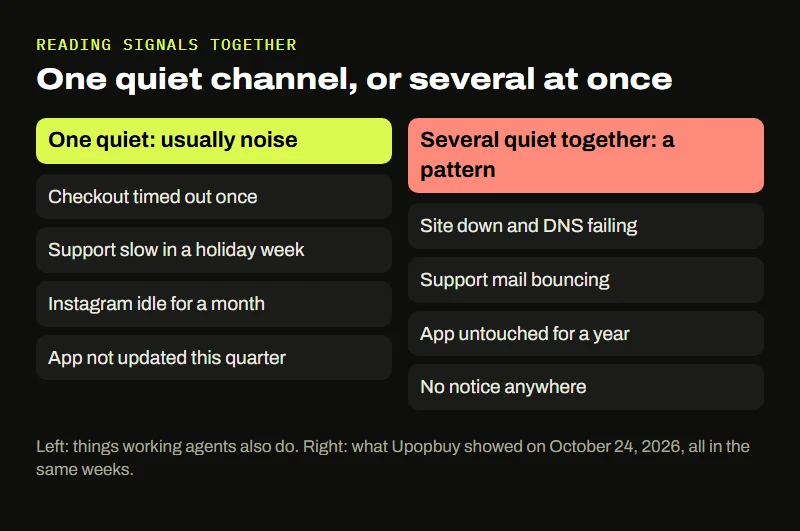
Every agent has bad afternoons. A checkout that times out once, a support queue that takes two days in the week before a national holiday, an Instagram account that went quiet because the person running it left: none of these, alone, says a business has stopped. What changes the picture is overlap. When the website, the mailbox and the app all fall silent in the same stretch of weeks, the odds that it is a coincidence drop fast.
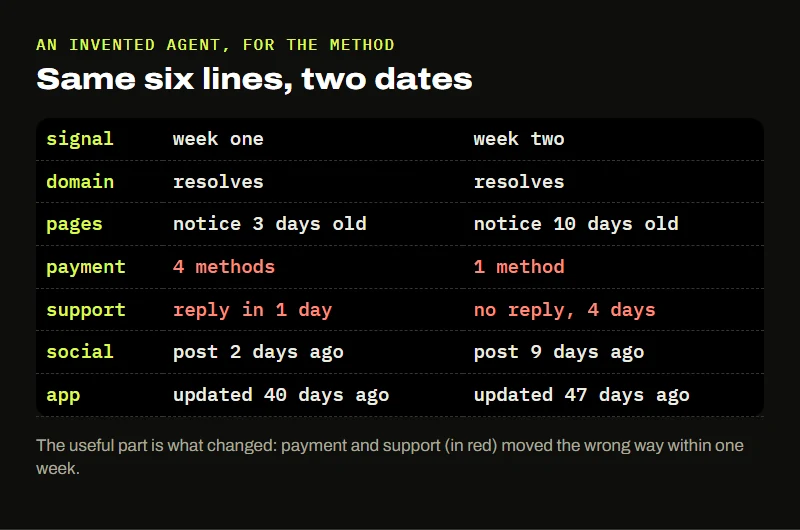
So the routine below is built to be repeated, not run once. You look at six places, write down what you saw and when, and look again before your next payment. A single reading tells you little. Two readings a week apart tell you which way things are moving.
We use Upopbuy as the worked example on every signal because its situation is unusual and well documented: the website stopped answering, while the iOS app stayed listed. Our readings are dated October 24, 2026. They describe what we could observe from the outside on that day and nothing more.
The domain and its name servers
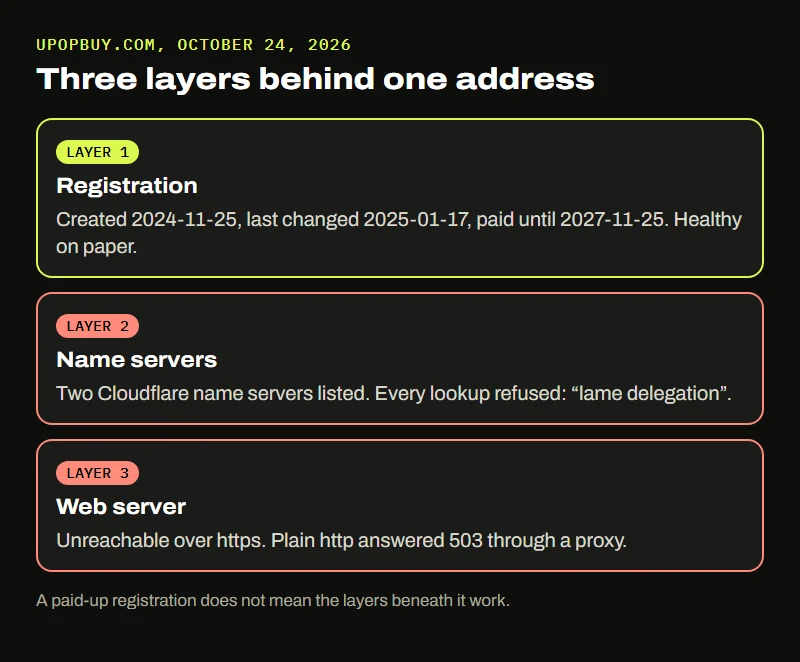
A website address works in three layers, and each one can fail on its own. Checking them in order tells you far more than “the site is down”.
- Registration. Look the domain up in a registration database (search for “RDAP lookup” or “WHOIS lookup”). Note three dates: when it was registered, when it was last changed, and when it expires. A domain that expires within weeks and has not been renewed is a real warning. A domain registered last month that claims years of history is a different kind of warning.
- Name servers. These are the machines that answer “where does this address live”. A public DNS lookup page (Google runs one at dns.google) will show either a normal answer or an error such as SERVFAIL. An error here means nobody’s browser can find the site, whatever state the shop behind it is in.
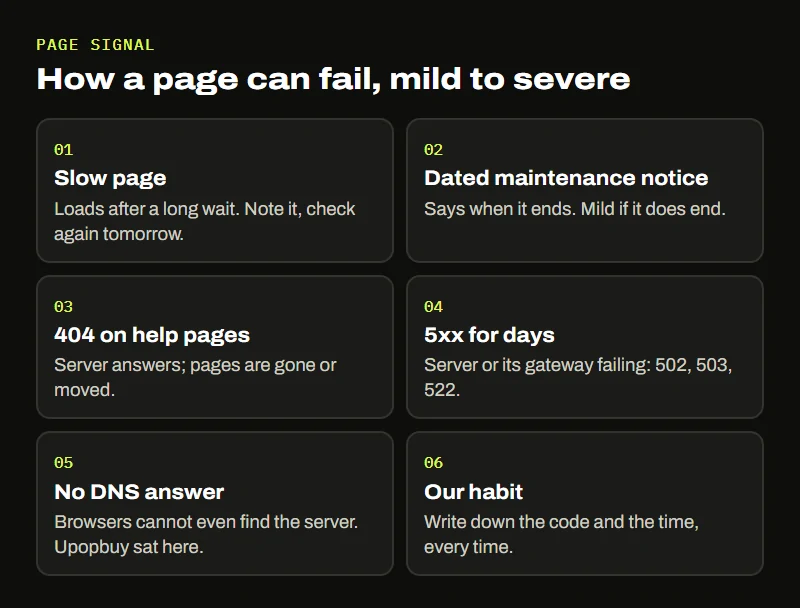
- The web server. If the first two layers are fine, the browser reaches a server. A slow page or a maintenance notice with a return date is mild. A 5xx error code that lasts for days is not.
Upopbuy, October 24, 2026: the registration record for upopbuy.com shows it was created on November 25, 2024, last changed January 17, 2025, and paid up until November 25, 2027. Its two name servers sit at Cloudflare, yet every lookup we sent came back refused (Google’s resolver called it a “lame delegation”; Cloudflare’s said “No Reachable Authority”). A domain can be paid for three years and still lead nowhere.
One more domain habit is worth building: read the spelling slowly. Shopping-agent names are short and often differ by a single letter. Upopbuy sits one letter away from Oopbuy, a separate agent. The two are different businesses, and nothing in the material we hold connects them. If a link, an ad or a message in your inbox uses a near-miss spelling, treat it as a stranger until you have run the same six checks on it.
The pages: error codes, dates and dead ends
When an agent’s site does load, the useful question is no longer “is it up” but “is anyone updating it”. Three places answer that quickly.
- The newest dated item. Announcements, a news strip, a blog, a banner for a seasonal sale. Note the date of the newest one you can find. Agents that are trading tend to post about holiday warehouse closures and line changes every few weeks.
- The help and policy pages. Open the fee page, the shipping page and the terms. Blank pages, pages that bounce you back to the homepage, or terms that still name a different company are worth writing down.
- The archive. The Internet Archive’s Wayback Machine (web.archive.org) keeps copies of many public pages. The list of capture dates for an address tells you roughly when pages existed and when they changed. For small sites the archive is patchy, so a gap proves little; a long run of captures that suddenly stops is more telling.
Status codes are worth learning to read. 404 means the server answered and the page is missing. 500 to 599 means the server, or the service in front of it, failed: 502 and 504 point at the machine behind a gateway, 503 means the service says it cannot handle the request, and 52x codes are specific to Cloudflare and mean it could not get a sensible reply from the shop’s own server. Any of these lasting more than a day or two is a signal on its own.
Upopbuy, October 24, 2026: the secure address (https) gave no connection at all, from our own line and through a proxy. The plain http address returned 503 through the proxy. The archive holds a homepage from November 26, 2024 and an English page from March 17, 2025, both only the scripts that would have drawn the page, plus a small advertising file captured March 29, 2025. We found nothing captured from the main site after that.
Payment: does the checkout still take money the ordinary way
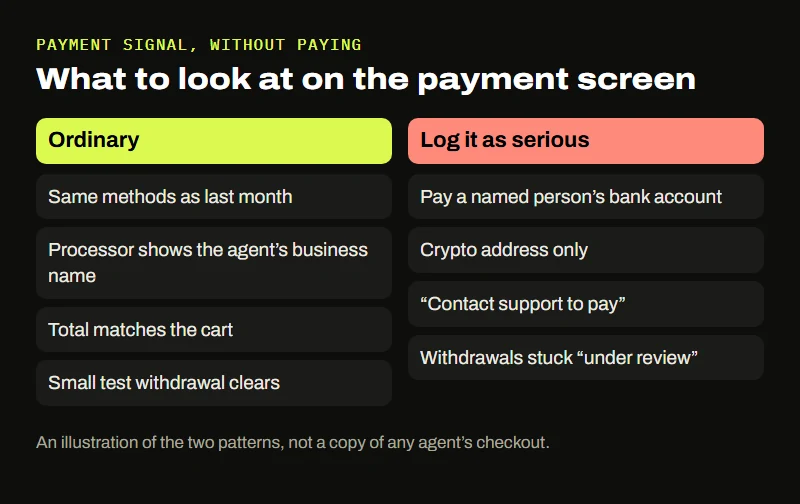
You can learn a lot about an agent’s health at the checkout without paying anything. Put a cheap item in the cart and go as far as the payment choice screen, then stop.
- Does the page load, and does the list of payment methods look the way it did last time? A shrinking list (cards gone, only one method left) is worth noting with the date.
- When you hover or click towards a card payment, whose name appears? A recognized payment processor showing the agent’s registered business name is normal. A request to send money to a named individual’s bank account, a crypto wallet address, or “contact support to pay” is not normal for a working agent, and we treat it as a serious sign.
- If you keep a wallet balance with the agent, try withdrawing a small amount. A withdrawal that used to take a day and now sits “under review” for a week, or a new fee on withdrawals with no notice, belongs in your log.
- Watch for top-up bonuses that grow unusually generous. A bonus is ordinary marketing; a sudden push to deposit large sums is the pattern to be wary of.
None of this is legal advice, and we do not tell readers what to do with a payment that has already gone through. If something looks wrong with a charge, the company that processed it can explain its own rules to you.
Upopbuy: with the website unreachable there is no checkout to look at, and the archive kept no payment page. Which payment methods Upopbuy accepted is not in the archive or in the App Store listing, so we leave that blank rather than guess.
Support: a question that gets a real answer
The cheapest live test is a question. Before you have an order, write to support with something specific and easy: “Does your warehouse accept parcels from 1688 sellers that ship in two boxes?” Note the time you sent it.
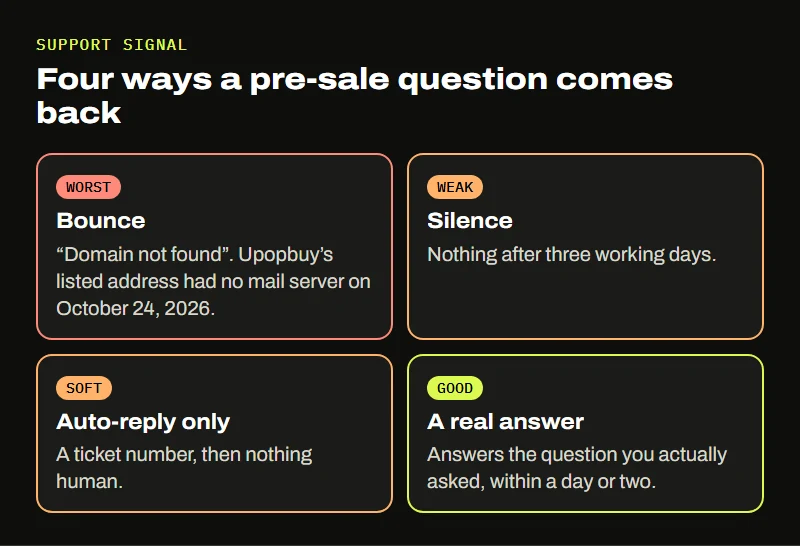
- An email that bounces back with “address not found” or “domain not found” is a serious sign. You can also look up the domain’s mail servers (an “MX lookup”) in the same DNS tool you used for the website.
- A chat window that only ever produces automatic replies, for days, is softer but still worth logging.
- A real reply that answers your actual question, inside a working day or two, is one of the best signs you can get.
Upopbuy: the App Store listing gives a service hotline (+86-755-33085566) and the email address [email protected]. On October 24, 2026 the mail-server lookup for upopbuy.com failed in exactly the way the website lookup did, which leaves mail to that address with no server to be delivered to. We did not phone the hotline, so we make no claim about it.
The app listing: version history, ratings and the seller line
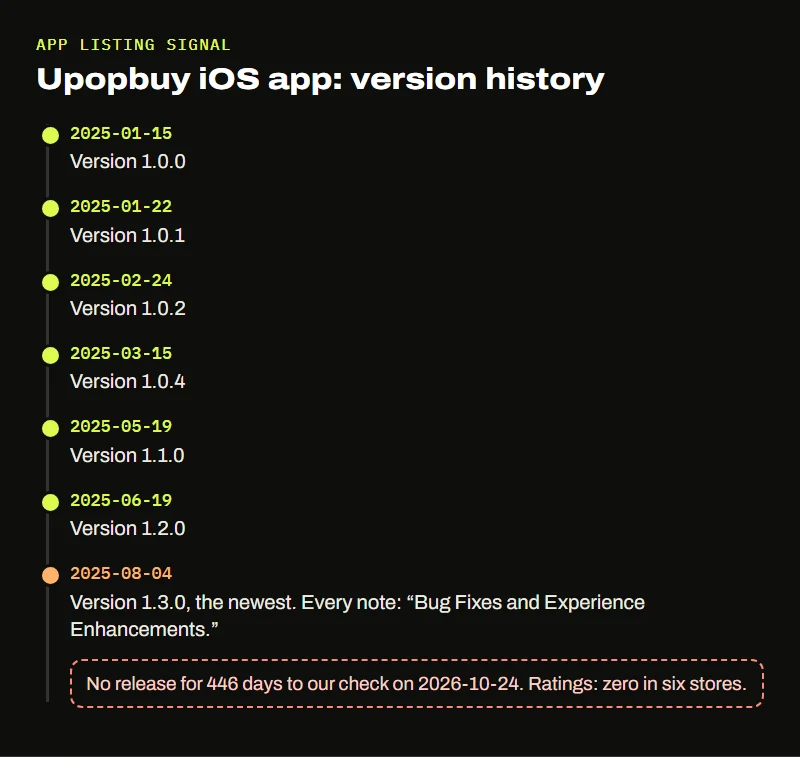
App stores keep records that a shop cannot quietly edit. On the App Store page, open “Version History” and note the date of the newest version. Then read the ratings count and the “Seller” line, and check that the developer’s website link points back to the same agent you are looking at. On Google Play, the “Updated on” date does the same job.
Two cautions. An app can stay listed long after the service behind it stops, because nobody has to remove it. And a new app with no ratings is normal; an app that has been listed for most of two years with no ratings in any of the stores you can check is less so.
Upopbuy, October 24, 2026: the iOS app is still listed in the US, UK, German, French, Canadian and Australian stores. Seven versions came out between January 15 and August 4, 2025, each with the note “Bug Fixes and Experience Enhancements.”, and nothing since. The rating count is zero in all six stores. Shenzhen Chengyu Technology Co.,ltd fills the seller line, while the developer website link points to www.upopbuy.com, the address that no longer answers. A Google Play lookup for the same package name returns 404.
Putting a date on each finding
A finding without a date goes stale the moment you write it. Keep one line per signal, in the same order every time:
2026-10-24 09:00 · domain · registered to 2027-11-25, name servers refuse · serious
Six lines, five minutes. Next time, compare line for line. You will see at a glance whether a quiet channel woke up or a second one went quiet. When you have your six lines, the signal reader turns them into one of three plain next steps, and its silence counter works out how many days each channel has been quiet.
If you are about to pay for something you found in our catalog, the money page covers what to keep small while you are still unsure, and the ordering walk-through shows where in an order each signal can be re-tested for free.
Social accounts: the latest post and who is commenting
Agents usually run a Discord server, an Instagram or TikTok account, sometimes a YouTube channel. Three readings are worth taking:
Follower counts say little; they can be bought and they rarely fall when a business stops.
Upopbuy: the archived pages are script shells with no visible footer, so they show no social links. Searches run on October 21 and October 24, 2026 found no official account, no official YouTube channel, no Reddit thread about the agent and no Trustpilot page. That is an absence of evidence, which makes the other five signals carry more weight.