Inside an order
Shipping from the warehouse: routes, box weight and numbers you can verify
Shipping is usually the largest single cost in an agent order and the stage where a parcel leaves the agent’s hands. Both make it a good place to slow down and check.
How agents present shipping lines
After your parcel is packed and weighed, the agent shows a list of lines: named routes with a price, an estimated delivery time and a list of what each will and will not carry. They fall into a few families. Postal lines (SAL, EMS and similar) are cheap and slow. Express couriers are fast and cost more. “Special lines” are agent-arranged routes that fly parcels in bulk and hand them to a local carrier for the last stretch; they sit between the two on price and speed. Sea freight exists for heavy parcels and takes months.
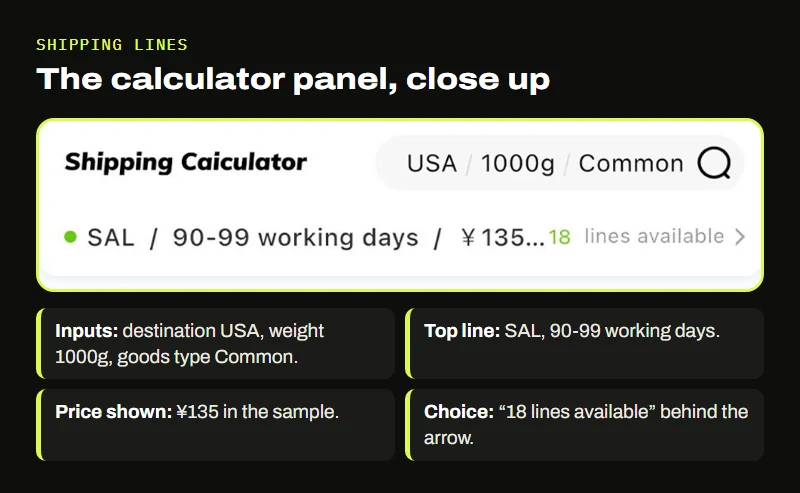
Upopbuy’s app screenshot shows its calculator with one sample: destination USA, weight 1000 g, goods type “Common”, top result SAL at 90 to 99 working days from ¥135, and “18 lines available”. We cite it to show the format, not as a quote. Ninety-odd working days is a long time for a parcel to be in transit, and the lowest quote can cost you a season of waiting.
Billed weight versus the scale reading
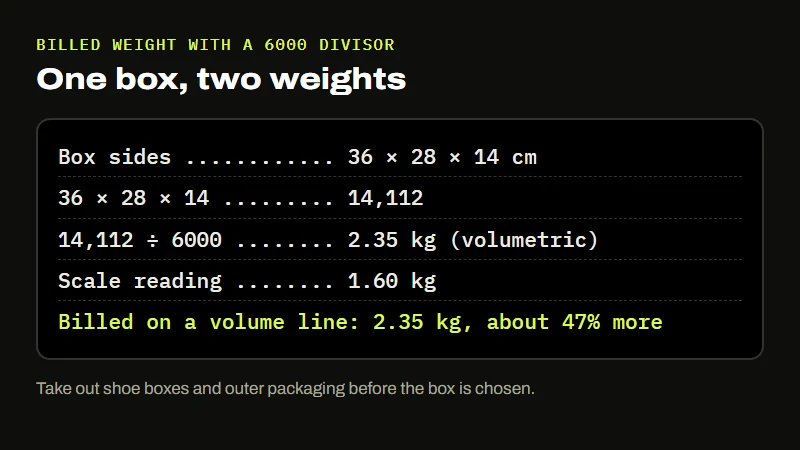
Many lines charge by whichever is larger: the real weight, or a size-based “volumetric” weight. The volumetric figure comes from multiplying length, width and height in cm and dividing by the divisor the line publishes.
A worked example, using a divisor of 6000: a box of 36 × 28 × 14 cm gives 14,112, and 14,112 ÷ 6000 is 2.35 kg. If the scale says 1.6 kg, a line that uses volume bills you for 2.35 kg, almost half as much again. Bulky, light items (fleece jackets, puffy knitwear, sneakers in their boxes) are where this bites.
The fixes are ordinary: ask the agent to remove shoe boxes and outer packaging, to vacuum-pack soft clothing, or choose a line that bills by real weight. Ask before the parcel is packed, not after.
Tracking numbers a carrier will recognize
Two tracking numbers matter in an agent order. The seller’s domestic courier number covers the trip into the warehouse; the international number covers the trip out to you. Both can be checked outside the agent: the domestic one on the Chinese courier’s own site or a general tracker, the international one on the carrier’s site in your country.
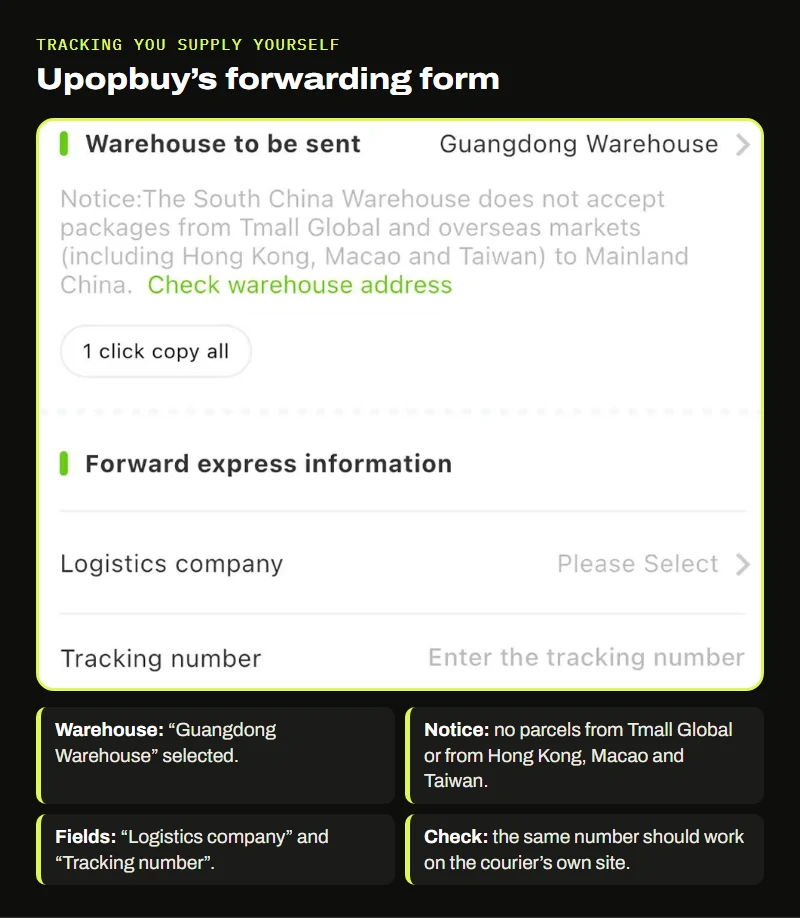
Upopbuy’s second screenshot shows the other direction, its forwarding form for parcels you bought yourself: a “Logistics company” picker, a “Tracking number” field, a warehouse labelled “Guangdong Warehouse”, and a notice that the South China warehouse turned away parcels sent from Tmall Global, Hong Kong, Macao and Taiwan. The principle is the same either way: a tracking number is only reassuring if someone other than the agent recognizes it.
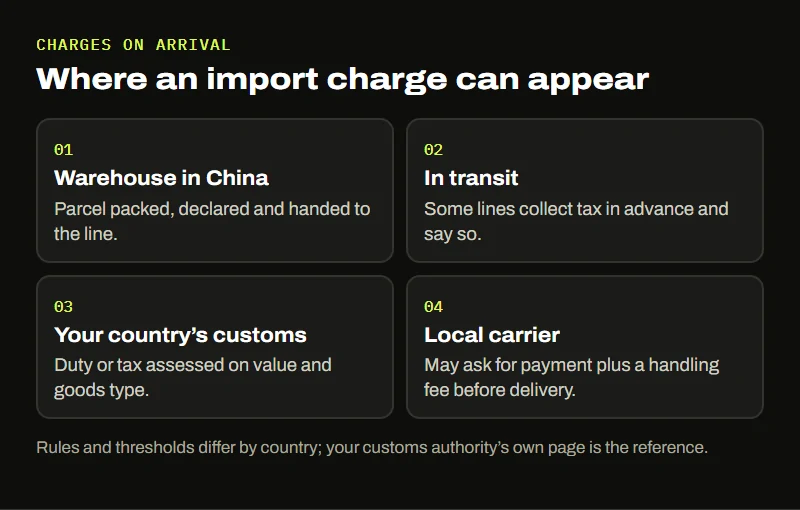
Import charges on arrival
Whether you pay anything at the door depends on your country, the value and type of goods, and the line. Some lines collect tax in advance and say so; others leave it to the local carrier, who may ask for payment before delivery and add a handling fee. Check your own customs authority’s page for the current threshold rather than relying on a figure from a forum.
The declaration on the parcel must describe what is inside. We do not advise on what value to declare. Keep the agent’s invoice and your order receipts together; the carrier may ask for them, and they are part of the records that matter if an agent later goes quiet.
Shelf items that limit which routes will carry them
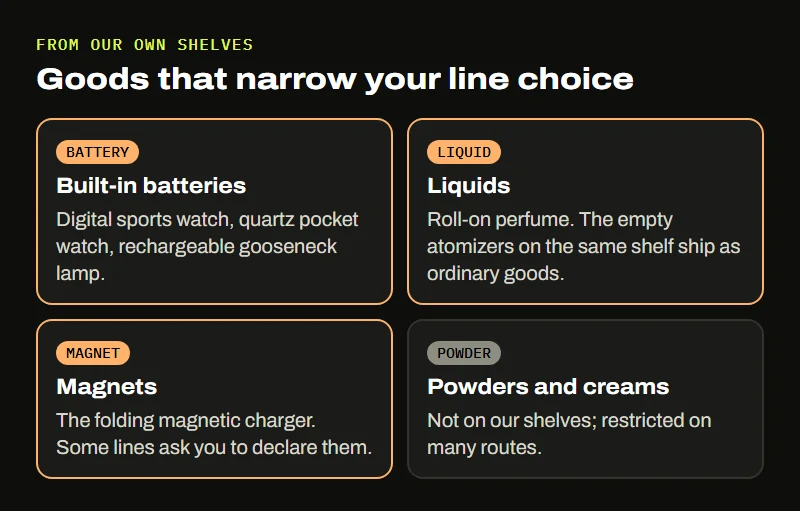
Some goods are refused by many lines or allowed only on specific ones. On our own shelves, four kinds come up:
- Built-in batteries: the digital sports watch, the quartz pocket watch and the rechargeable gooseneck lamp. Look for lines marked for battery goods.
- Liquids: the roll-on perfume. Many air lines refuse perfume; the empty spray atomizers on the same shelf travel as ordinary goods.
- Magnets: the folding magnetic charger is built around them, and some lines ask you to declare that.
- Powders and creams: not on our shelves, but common in mixed orders and restricted on many routes.
If one restricted item is mixed into a parcel of ordinary clothing, the whole parcel can be limited to the lines that accept it. Splitting it into two parcels is sometimes cheaper.