Before money moves
Money at a buying agent: what you pay, the rate you get, and what sits there
Fees differ from agent to agent and change often, so this page teaches the arithmetic rather than quoting anyone’s rates. The Upopbuy fee schedule is not in the archive or the app listing, and we leave it blank.
Sections on this page
Cost breakdown of a typical agent order
An agent order is paid in two instalments, with a possible third at your door. Knowing which charge sits where makes it much easier to spot a quote that does not add up.
Start with the selected option and quantity, then mark every other line as quoted, optional or not yet known. An unavailable Upopbuy price list cannot be filled with another agent’s fee or a zero. The generic order guide separates the goods payment from parcel submission; retain the written quote for each before paying.
- The item price, exactly as the marketplace shows it for the option you chose.
- The seller’s domestic delivery to the agent’s warehouse, often ¥0 to ¥15 inside China.
- The service fee. Some agents charge a percentage of the goods, some a flat amount per order, some nothing at all and earn on the currency conversion or on shipping instead. A “no service fee” claim is only half an answer until you know the exchange rate.
- Payment processing, sometimes shown as a separate line for cards or PayPal.
- International freight and packing extras, paid at the second instalment once the parcel is weighed.
- Import duty or tax, if your country charges it, collected by the carrier.
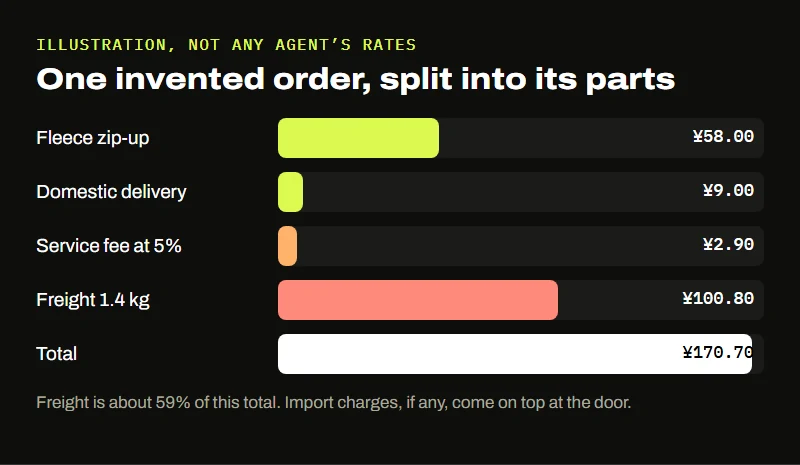
The figure below runs one made-up order through those lines. The numbers are an illustration we chose, not any agent’s rates: a ¥58 fleece zip-up, ¥9 domestic delivery, a 5% service fee for the sake of the sum, and a 1.4 kg parcel at an invented ¥72 per kilo.
Working out the exchange rate an agent applied
When you pay in dollars, euros or pounds for goods priced in yuan, the agent converts at a rate of its choosing. You can work it out after any payment with one division.
Use matching amounts: the CNY credit or order value actually funded, and the full charge in one payment currency. If that charge includes processing fees, this division gives an effective all-in conversion, not the agent’s exchange rate alone. Separate those fees when comparing quoted currency rates, and keep the same amount and payment channel for a useful comparison.
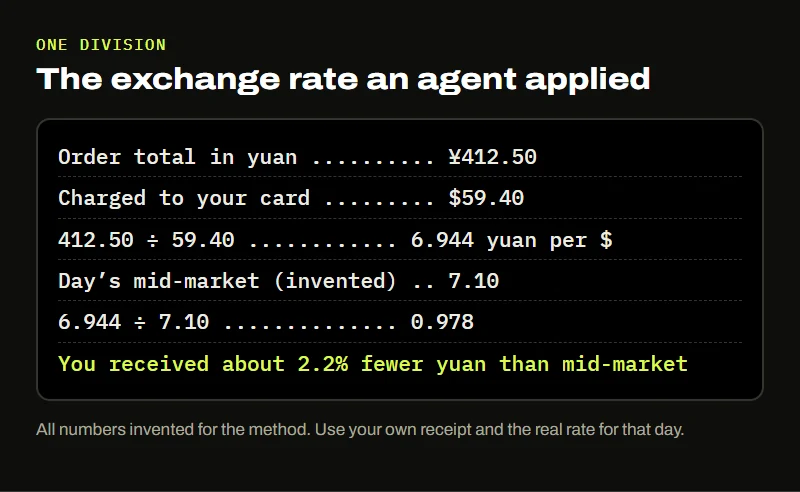
- Take the total in yuan shown on the order (say ¥412.50).
- Take the amount your card or account was actually charged (say $59.40).
- Divide: 412.50 ÷ 59.40 = 6.944 yuan for each dollar you paid.
- Look up the mid-market rate for that day on any currency site. If it was 7.10 (an invented figure for this example), you received 6.944 ÷ 7.10 = 0.978 of the yuan you would get at mid-market, so about 2.2% less.
A gap of a few per cent is how many agents and card schemes earn money and is not a warning by itself. What belongs in your log is a gap that grows between one order and the next without any notice, or a rate on the checkout page that differs from the rate on the receipt.
Money left parked at the agent between orders
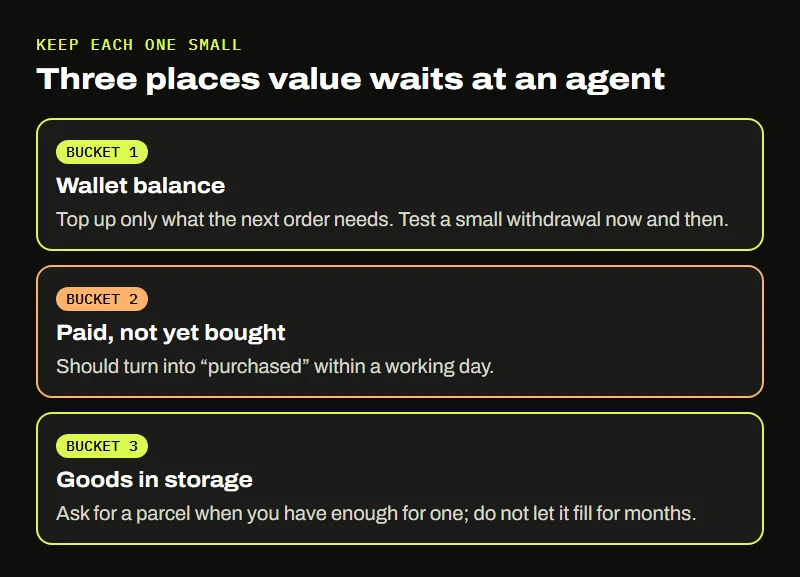
At any moment, three kinds of value can be sitting with an agent on your behalf: a wallet balance you topped up, items paid for that the agent has not yet bought from the seller, and goods in storage waiting for a parcel. When an agent stops answering, all three are stuck at once.
The habit that keeps this small is dull and effective. Load the wallet with the next order’s cost and no more. Ask for a parcel when you have enough items for one, rather than letting storage fill up for months because the free period is long. Upopbuy’s listing offered 90 days of free storage, which is generous; a long free period is a convenience, not a reason to leave goods sitting.
If you already keep a balance somewhere, check the available refund or withdrawal route, its fee and processing conditions before adding more funds. A completed withdrawal is evidence of that transaction only, not a guarantee of later access.
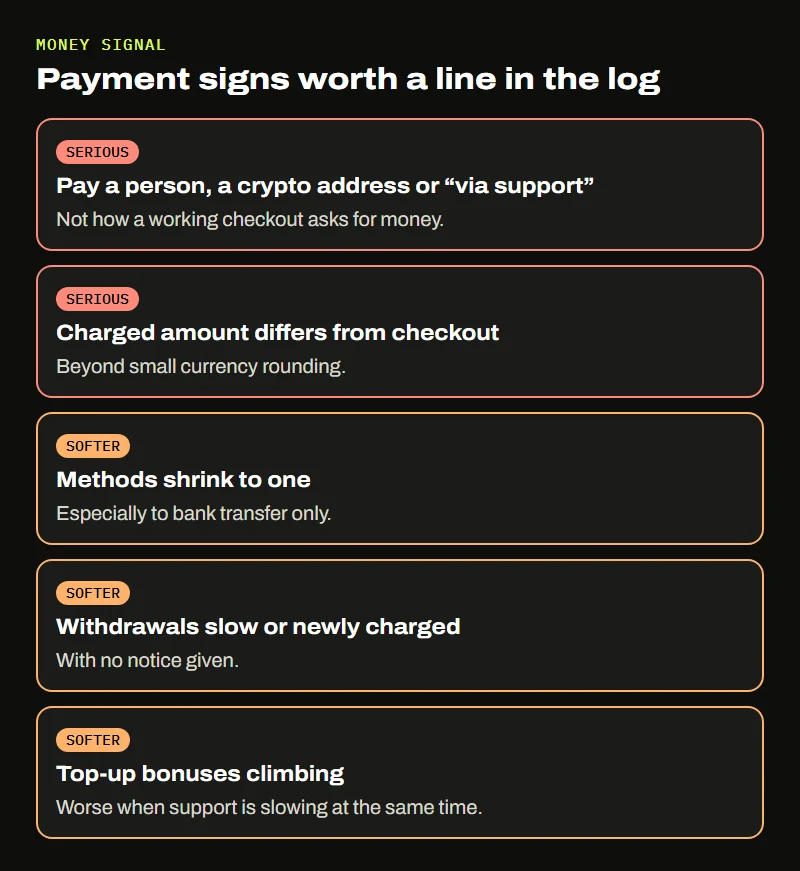
Payment signs worth a line in your log
These are the money-side warnings we watch for. The serious ones are also boxes in the signal reader.
- The list of payment methods shrinks to one, especially to a bank transfer.
- Payment instructions point to a named individual’s account, a crypto address, or a chat window instead of the checkout.
- Withdrawals that used to clear in a day now sit under review, or carry a new fee nobody announced.
- Top-up bonuses climb sharply, especially alongside slower support.
- The amount charged does not match the checkout total, beyond small currency rounding.
We do not give advice on disputing a charge or on any legal step. If a payment already made looks wrong, the bank, card issuer or wallet company that handled it can explain what it offers under its own rules.