Before money moves
Sellers and items: settling the details on the marketplace page
An agent buys exactly what you select. If the option is wrong or the seller is careless, a perfectly healthy agent will still ship the wrong thing. Every example below comes from a listing on our shelves, read on October 24, 2026.
Shop headers read for staying power
Taobao and 1688 show different things about a seller, so read each in its own way.
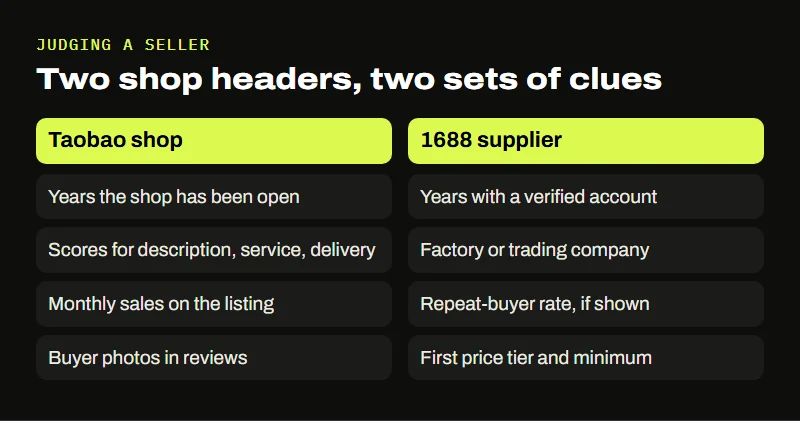
- On Taobao, open the shop header. Look at how long the shop has been open, the three shop scores for description, service and delivery, and the monthly sales figure on the listing. A shop that has sold the same item steadily for a year is a better bet than one with a single viral listing.
- On 1688, look for the number of years the seller has held a verified account, whether it describes itself as a factory or a trading company, and its repeat-buyer rate if shown. Factories often have the lowest prices and the thinnest English.
- On both, read a few reviews with buyer photos, not the star average. Photos taken in ordinary light tell you about color and fabric; the seller’s studio shots do not.
Stock figures deserve a glance too. The waffle henley on our T-shirt shelf showed 246 pieces across 54 color and size choices on the day we read it, so a popular size can run out between your order and the agent’s purchase. Ask your agent to cancel rather than substitute if the exact option is gone.
Three habits for option menus that hide the real price
The option menu is where most surprises start. Three habits catch nearly all of them:
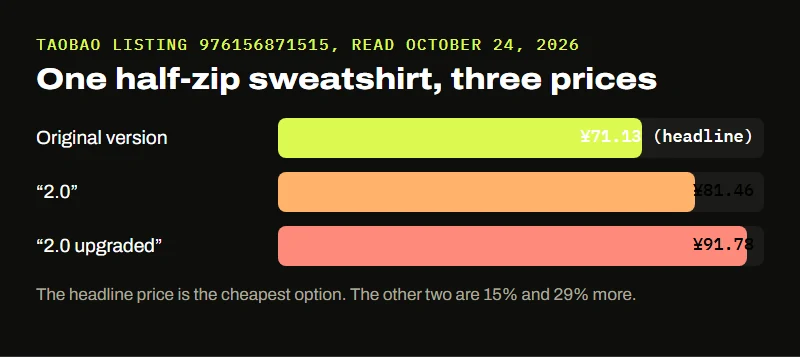
- Open every price in the menu, not just the headline. The headline is usually the cheapest option. The half-zip sweatshirt on our hoodie shelf is ¥71.13 in its original version, ¥81.46 for a “2.0” version and ¥91.78 for the “2.0 upgraded” one. The flared jeans run from ¥72.23 to ¥82.56 for a “better quality” option and ¥92.89 for a fleece-lined pair, each also offered in an extra-long cut. Sharpest of all: the floral slip dress on our women’s shelf shows a dress and cardigan together, but its ¥24.37 headline buys only the cardigan. The dress alone is ¥40.76.
- Read option names in Chinese as well as English. Machine translation mangles color names. A softshell jacket on our outerwear shelf lists a pink shade that comes out in English as “Freud powder”, and every color carries the style code MYJ25-7986 in front of it.
- Check the attribute list against the title. A hooded jacket at ¥32 calls itself waterproof in the title, while its attribute list claims only windproof. Another ¥14 crewneck is marked in its attributes as part of a set. Neither is necessarily wrong, but both are questions to put in a note to the buyer before paying.
Six snags hiding in otherwise sound listings
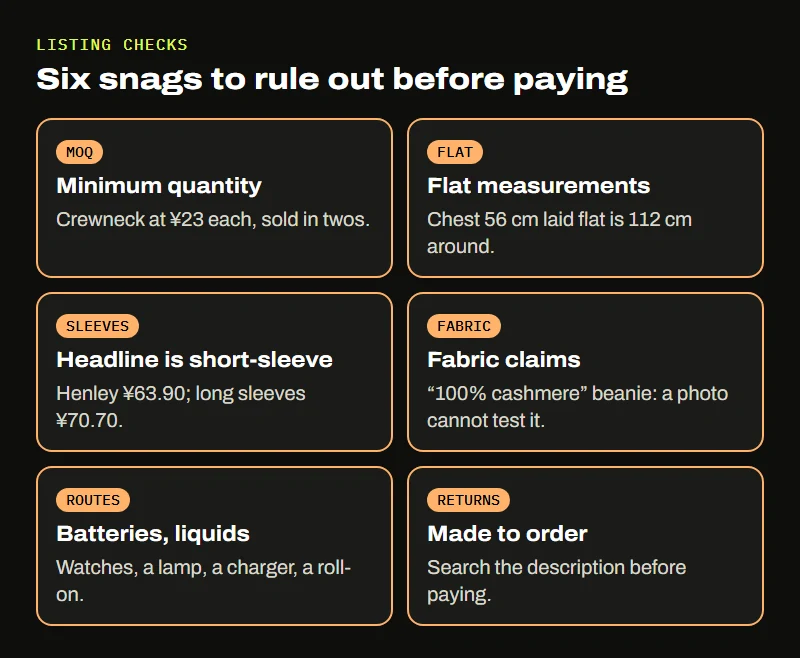
- Minimum quantities. On 1688 the first price tier sets the minimum. The oversized crewneck on our hoodie shelf is ¥23.00 each, but sold in pairs at minimum. We print the minimum on every card where it is above one.
- Flat measurements. Size charts often give chest width laid flat. Double it before comparing with your own chest.
- Short sleeves at the headline price. The waffle henley at ¥63.90 is the short-sleeve version; the long-sleeve one in the same listing is ¥70.70.
- Fabric words. The cashmere beanie on our hat shelf is sold as 100% cashmere, a claim no warehouse photo can test. The ¥25 polo’s title is silent on fabric, and only the attribute list admits to a synthetic blend.
- Batteries and liquids. They limit which shipping lines will take the parcel, as the shipping page explains.
- Custom or made-to-order notes. Some listings say made-to-order items cannot be returned. Search the description for it before paying.
Why every pick on our shelves is unbranded
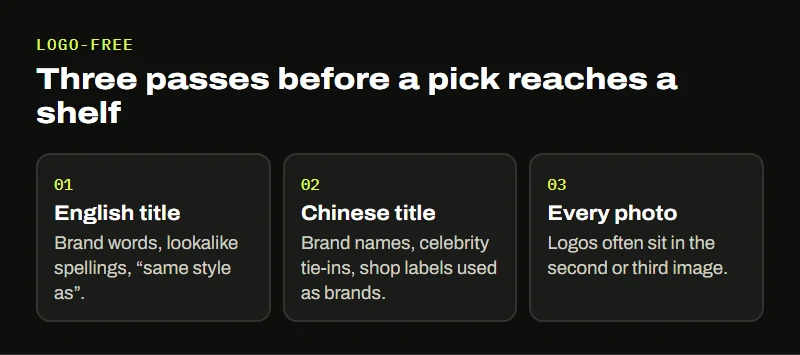
We list plain goods only: no brand names, no logos, no “same style as” claims, no celebrity tie-ins in the title. We filter titles in English and Chinese and then look at every photo, because brand marks often hide in the second or third image. When a listing passed the filters but showed a logo on close inspection, we dropped it.
The reason is practical as much as anything. A plain fleece or a pair of pearl studs lets the catalog talk about the things that change what arrives (options, minimums, size charts, shipping limits) instead of about labels.